
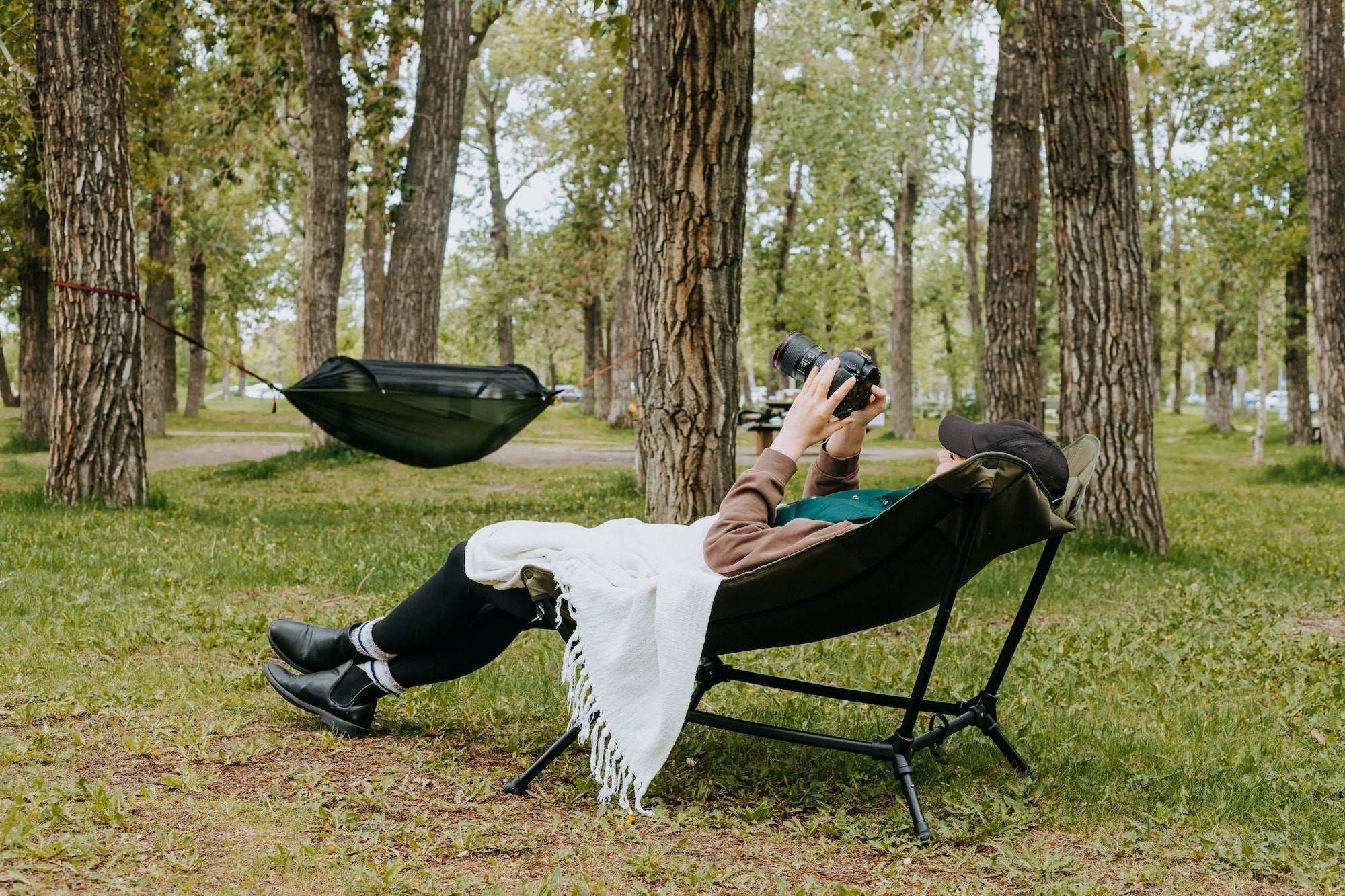
Canada might be the best hammock country on earth. We have more forest than almost anywhere, thousands of lakes, and summer evenings that stay light until ten. We also have blackflies, sudden cold snaps, and park rules that change from one province to the next. This guide covers what you need to know to pick the right hammock in Canada and actually enjoy sleeping in it.
Why hammocks make sense for Canadian camping
Much of Canada's best camping is on ground that's terrible for a tent. Think rocky Canadian Shield, root-tangled boreal forest, sloped sites on the BC coast, and soggy shoreline in the Maritimes. A hammock doesn't care what's underneath. All you need are two healthy trees.
- No flat ground needed. Rock, roots, slopes and wet ground stop being problems.
- Drier in the rain. You're off the ground, so pooling water can't reach you.
- Lighter to carry. A complete hammock setup often weighs less than a tent, pad and footprint, which helps on portages.
- Not sure which is right for you? Read our full comparison: Hammock Camping vs Tent Camping in Canada.
- Better sleep for many people. A well-hung hammock takes pressure off your hips and shoulders.
Types of hammocks sold in Canada
1. Camping hammocks with a built-in bug net
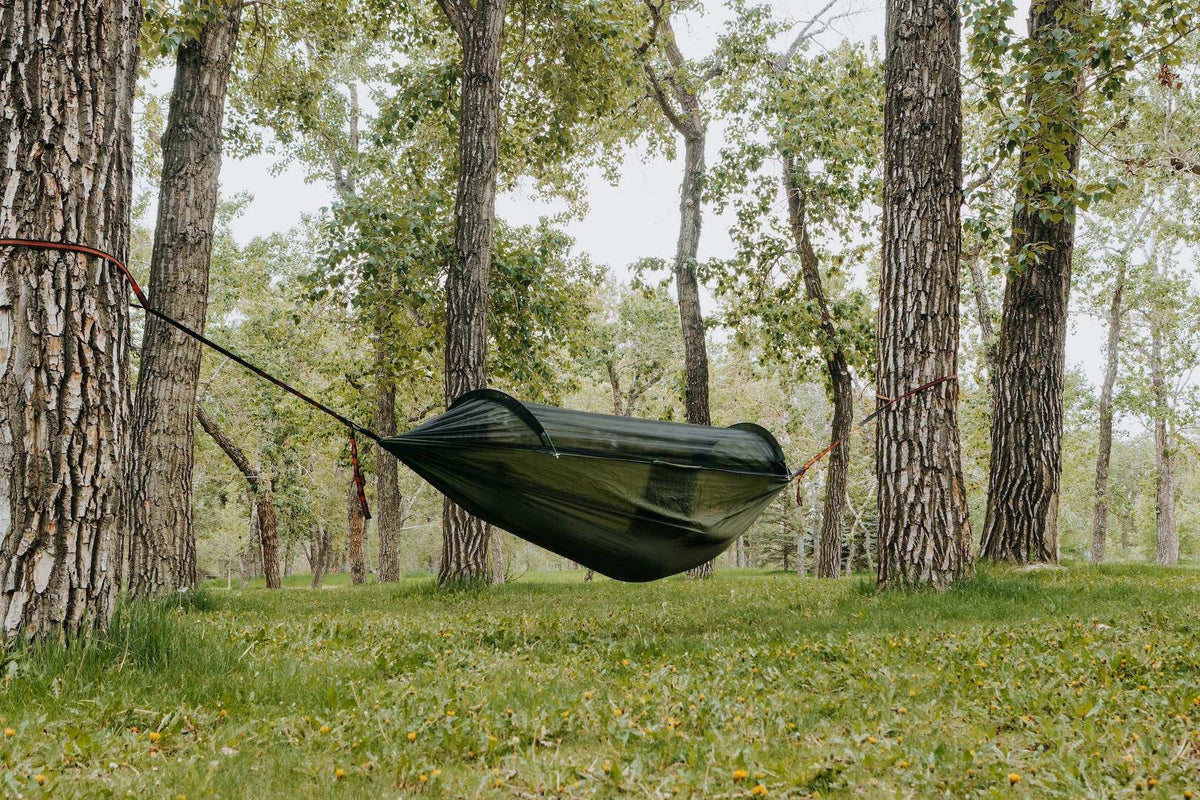
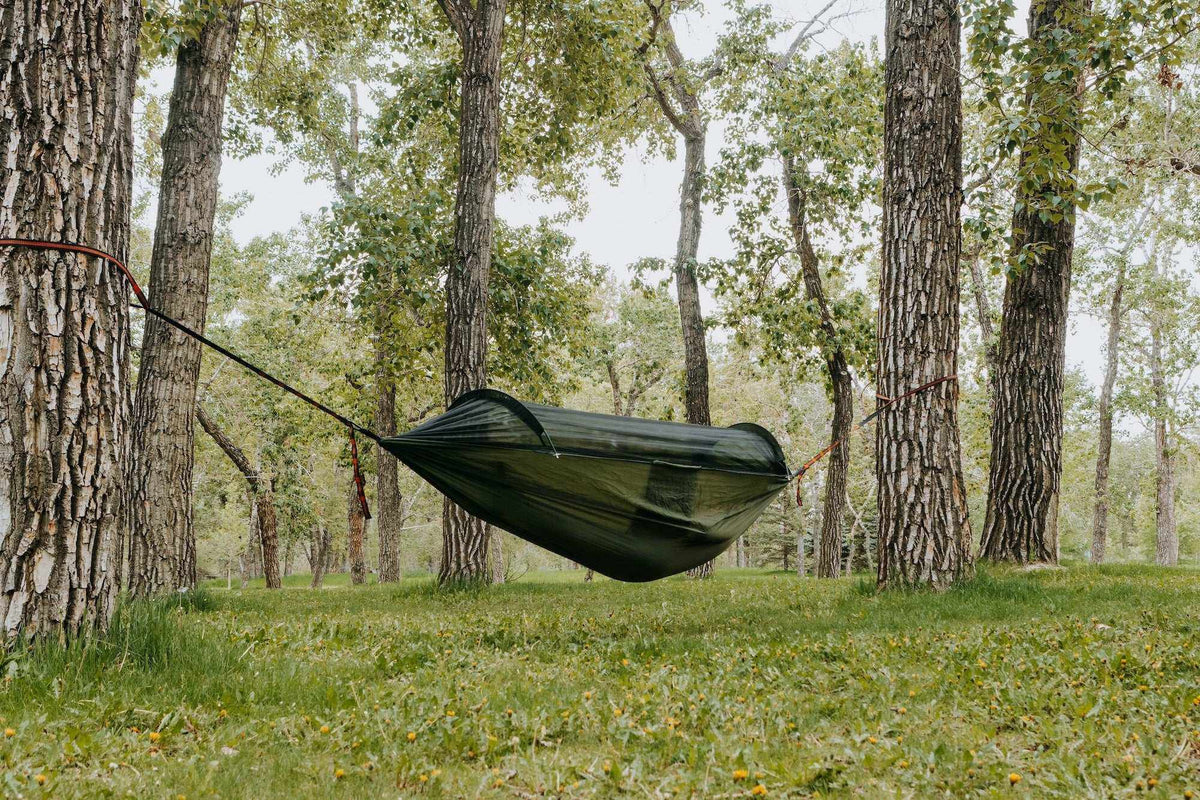
This is the one most Canadian campers should buy. From late May through July, mosquitoes and blackflies make an open hammock miserable in most of the country. A fully enclosed net keeps them off you while still letting air through on warm nights. Look for tear-resistant ripstop nylon, a zip-closed net, and at least 150 kg of weight capacity.
Our Portable Camping Hammock with Mosquito Net was designed around exactly this problem. It has 70D ripstop nylon, an integrated mosquito net, and aluminum support poles that hold the net off your face. It's 290 × 140 cm when pitched, weighs 1.2 kg (2.6 lbs), supports 150 kg (330 lbs), and packs down to 38 × 33 × 8 cm.
2. Lightweight "parachute" hammocks
These are simple nylon hammocks with no net. They're great for day hikes, the beach, the cottage dock or a lunch stop. They're less useful for overnight trips in bug season.
3. Backyard and rope hammocks
Cotton rope and quilted hammocks with spreader bars look great on a deck. They aren't built for the backcountry. Cotton soaks up water and is slow to dry in a humid Ontario or Quebec summer, so bring them in when you're not using them.
4. Hammocks with stands
Don't have two trees? A steel or wooden stand lets you set up on a balcony, patio or lawn. This is a good option for condo dwellers in Toronto, Vancouver or Montreal.
What to look for when buying a hammock in Canada
Here's a quick checklist. For more detail, see Essential Tips for Choosing a Camping Hammock.
| Feature | What to look for | Why it matters here |
|---|---|---|
| Bug protection | Fully enclosed, zippered net | Blackfly and mosquito season covers most of the camping season |
| Fabric | Ripstop nylon (70D or heavier for durability) | Resists snags from branches and dries quickly after rain |
| Weight capacity | 150 kg / 330 lbs or more | Leaves a safety margin for you and your gear |
| Size | At least 2.7 m (9 ft) long | Longer hammocks let you lie diagonally and flatter |
| Packed size and weight | Under ~1.5 kg for backpacking | Every gram counts on long portages and alpine trails |
| Suspension | Wide, tree-friendly straps | Protects bark, and many parks expect it |
How to hang a hammock (the right way)
- Pick healthy trees about 4–5 metres apart. Each trunk should be at least as thick as your thigh. Avoid dead trees and trees with dead branches overhead (the "widowmakers").
- Use wide straps, never rope. Thin rope cuts into bark and can damage or kill the tree.
- Hang the straps at roughly a 30° angle. A hammock pulled tight like a banjo string puts huge force on the anchors and is uncomfortable. A gentle sag is what you want.
- Keep the seat low. About chair height (roughly 45 cm off the ground) is easy to get into and safe if something slips.
- Lie diagonally. Angling your body across the hammock flattens it out and stops you from curling into a banana shape.
- Test it before trusting it. Sit down with your weight close to the ground before you lie back.
For a step-by-step walkthrough, see Setting Up Your Portable Hammock Easily. You'll find more trail-tested advice in Essential Tips for Hammock Camping Adventures.
Staying warm: hammock camping in the Canadian shoulder seasons
Air moving under a hammock pulls heat from your back fast. Hammock campers call it "cold butt syndrome." Even a mild 10 °C night in September in the Rockies or northern Ontario can feel cold. A sleeping bag doesn't fix it, because the insulation underneath you gets crushed flat. (Wondering how hammocks compare with tents for warmth? We cover that in Does Camping in a Hammock Keep You Warmer Than a Tent?)
- Add an underquilt or sleeping pad. An underquilt hangs below the hammock and stays lofted. A closed-cell or inflatable pad inside the hammock is a cheaper option.
- Pitch a tarp over the top. It blocks wind and rain, which matters a lot on the coast and on exposed lakeshores.
- Choose sheltered spots. Avoid open ridgelines and cold valley bottoms where cold air settles overnight.
- Pair it with a good sleeping bag. Check the comfort rating, not the limit rating. See our camping gear for options.
Can you hammock in Canadian parks?
Usually yes, but rules vary by park, province and even campground. A few general guidelines:
- Check the park's rules before you go. Parks Canada and each provincial park system set their own policies. Some campgrounds ban attaching anything to trees, and others only allow it on your own site.
- Always use tree-friendly straps. Wide straps protect bark and are the standard Leave No Trace practice.
- Don't hang from park structures such as signs, shelters or bridges unless they're clearly made for it.
- Pack it all out. Take down your hammock when you leave the site so nobody's ever looking at a strap left on a tree.
Best places to hang a hammock in Canada
- Algonquin and the Ontario canoe country: Shield rock and dense forest make hammocks ideal for interior campsites.
- Banff, Jasper and Kananaskis: Cool nights, so bring insulation. The views from a hammock are hard to beat.
- Vancouver Island and the BC coast: Wet ground and big trees. Pack a tarp.
- The Laurentians and Mauricie in Quebec: Lake-dotted forest and lots of good hanging spots.
- Cape Breton and Fundy in Atlantic Canada: Coastal breezes help keep bugs down, but the wind makes a tarp useful.
Hammock safety tips
- Check your straps and carabiners for wear before every trip.
- Never exceed the hammock's rated weight capacity.
- Don't hang near cliffs, water's edge drops or over rocks.
- Health Canada advises against using hammocks for infant sleep. Babies can roll and become wedged in the fabric. Keep infants in a crib or bassinet.
- In bear country, keep food and scented items out of your hammock and stored properly, just as you would with a tent.
Hammocks in Canada: frequently asked questions
Is it legal to hang a hammock in Canadian parks?
In many parks, yes, but it depends on the park and campground. Check the specific park's website before your trip, use wide tree-friendly straps, and never hang from park structures.
What's the best hammock for camping in Canada?
For most Canadians, it's a camping hammock with a fully enclosed mosquito net. Bug season covers most of the camping season. Look for ripstop nylon, at least 150 kg of capacity, and a packed weight under about 1.5 kg.
Can you sleep in a hammock all night?
Yes. Many people sleep better in a hammock than on the ground. Lie diagonally to get a flatter position, and use an underquilt or pad when nights drop below about 15 °C.
How cold is too cold for hammock camping?
With the right insulation underneath (an underquilt or a good pad) plus a rated sleeping bag and a tarp, many campers are comfortable near freezing. Without insulation underneath, even 10–15 °C can feel cold.
How far apart should trees be for a hammock?
Around 4–5 metres apart works for most camping hammocks. Adjust the strap height so the hammock hangs at roughly a 30° angle.
Do you ship hammocks across Canada?
Yes. Yatta Life ships across Canada, with free shipping on orders over $100. Canadian orders usually arrive in 5–7 business days.
Ready to hang?
A good hammock can change how you camp in Canada. You'll worry less about finding flat ground and sleep better in the bush. Take a look at our Portable Camping Hammock with Mosquito Net and the rest of our portable hammocks, built for Canadian trails, lakes and bug season.

Leave a comment
All comments are moderated before being published.
This site is protected by hCaptcha and the hCaptcha Privacy Policy and Terms of Service apply.